Oral GLP-1 vs Injection Pens: What's the Difference, Which to Choose
Oral GLP-1 pills vs injection pens — frequency, use conditions and Thai FDA status in 2026, which is actually available today, and how doctors choose.
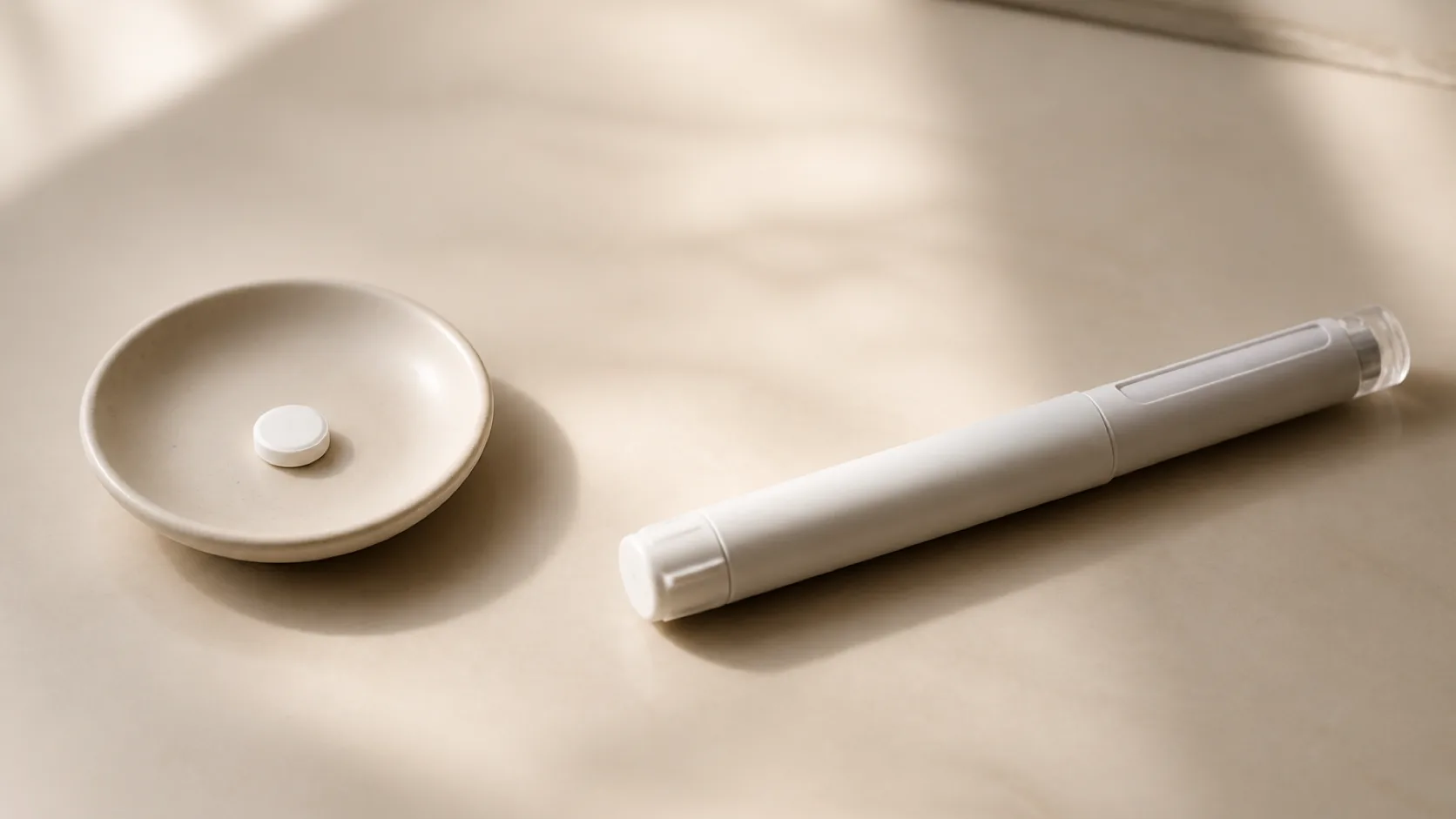
Oral GLP-1 pills and injection pens belong to the same drug class and work on the same principle. The key differences are frequency (a daily pill vs a weekly injection), use conditions, and — most decisive for patients in Thailand right now — registration status: as of August 2026, based on public Thai FDA records, every GLP-1 registered for weight management in Thailand is an injectable.
What forms does GLP-1 come in?
GLP-1 receptor agonists split into two broad forms by how they’re taken:
- Subcutaneous injection pens — the widely used group today, e.g. Mounjaro (tirzepatide, a dual GIP + GLP-1 agonist), Wegovy and Ozempic (semaglutide), and Saxenda (liraglutide). Most are injected once weekly; liraglutide is daily.
- Oral tablets — currently two main types: oral semaglutide (Rybelsus), a peptide in pill form, and orforglipron (Foundayo), the first small-molecule (non-peptide) oral GLP-1 approved in the US (April 2026) for long-term weight management.
Both forms mimic the GLP-1 hormone released after eating: you feel full sooner, appetite drops, and stomach emptying slows — helping many people eat less. Individual response varies.
Which forms are actually usable in Thailand today?
A point worth separating clearly: what “exists in the world” and what is “actually usable in Thailand” are not the same thing. The status as of August 2026, from public records:
| Drug | Form | Thai status (Aug 2026) |
|---|---|---|
| Mounjaro (tirzepatide) | Weekly injection pen | Thai-FDA registered (no. 1C 18/67(NC)), a special-control drug — original registered indication focused on type 2 diabetes |
| Wegovy (semaglutide) | Weekly injection pen | Thai-FDA registered |
| Saxenda (liraglutide) | Daily injection pen | Thai-FDA registered |
| Rybelsus (oral semaglutide) | Daily tablet | Thai-FDA registered — per product information, the primary indication is type 2 diabetes |
| Orforglipron (Foundayo) | Daily tablet | No registration information yet |
Registered indications differ per drug — some are registered for weight management, others primarily for type 2 diabetes. The summary: the GLP-1 pill available in Thailand today (Rybelsus) is not registered specifically for weight management, and the GLP-1 options doctors currently use for weight management are injection pens. Which drug applies to you is a medical decision based on your indication.
Pill vs pen — where exactly do they differ?
| Aspect | Oral pill | Injection pen |
|---|---|---|
| Frequency | Every day, once daily | Mostly once weekly |
| Use conditions | Oral semaglutide requires an empty stomach and limited water · orforglipron has no fasting requirement | Same day each week, any time of day as directed |
| Storage | Room temperature, travel-friendly | Mostly refrigerated per label |
| Consistency required | Must remember daily | Just once a week |
| Needles | None | Very fine needle, subcutaneous |
| Thai weight-management status (GLP-1 pill vs GLP-1 pen) | None registered directly | Several registered |
The overlooked factor is consistency: a pill sounds easier, but it must be taken correctly every single day, while a pen only needs remembering once a week. For some people the weekly injection is actually easier to sustain than a daily tablet — your own habits matter as much as the drug.
Is one more effective than the other?
Each drug’s trial figures were measured in different populations and conditions, so they can’t be pitted against each other directly. What current data supports: the new pills produce weight loss in the same direction as injectable GLP-1s — e.g. orforglipron’s phase-3 ATTAIN-1 trial reported an average of about 12% weight loss over 72 weeks at the study’s top dose, while each injectable has its own figures from its own trials.
More important than trial averages: individual results spread widely, depending on the dose reached, dietary change, and your body’s response. Trial numbers are a directional guide, not a promise — individual outcomes are never certain.
Do side effects differ?
The symptoms fall in the same class-wide group, because these are the same drug class — but frequency and severity differ per drug according to each one’s trial data. The common effects of both pills and pens are gastrointestinal: nausea, constipation, diarrhea and vomiting, mostly early on or when stepping the dose up, and usually easing as the body adjusts. Starting low and titrating gradually under a doctor’s care reduces the chance of these.
Precautions and contraindications follow each drug’s label — common examples include pregnancy or planned pregnancy, a history of pancreatitis, or a family history of certain thyroid cancers. A doctor always takes your history and assesses before starting.
Which should you choose — the factors doctors weigh
The most useful answer is: “the one that fits your circumstances and is actually usable for your indication.” Doctors typically weigh:
- Indication and Thai availability — is the goal weight management or diabetes care, and is that form registered for the matching indication?
- Daily habits — are you better with daily discipline (pill) or weekly (injection)?
- Feelings about needles — highly needle-anxious patients may suit a pill once one is registered for the matching indication; meanwhile, current pens use very fine needles and doctors teach self-injection until you’re comfortable.
- Health conditions and current medicines — the main determinant of which drug is possible at all.
- Follow-up — every option requires periodic medical follow-up for both results and side effects.
At Onnyx Clinic, the physician runs a doctor-supervised weight-management program using Thai-FDA-registered medicines, with a health assessment before every case, injection training, and ongoing follow-up. If you’re interested — or undecided while waiting for the pill — consult the doctor via LINE @onnyxclinic or 092-789-0742. Results vary by individual.
References
- Rybelsus (oral semaglutide) drug registration — Thai FDA National Drug Information database
- FDA approves Foundayo (orforglipron) — Eli Lilly press release
- Eli Lilly — ATTAIN-1 results (orforglipron)
- Oral GLP-1 receptor agonists in obesity management — PMC
- Thai Food and Drug Administration (FDA)
- Thai FDA National Drug Information database — for checking any drug’s registration status
Frequently asked questions
Which works better — the GLP-1 pill or the injection? +
Direct number-to-number comparison isn't possible: each drug was measured in separate trials with different populations and conditions. What can be said is that both forms act in the same direction as the GLP-1 class. Real results depend on the specific drug, dose, lifestyle changes and individual response — a doctor can assess which option fits you.
Is there a GLP-1 pill for weight loss in Thailand right now? +
As of August 2026, based on public Thai FDA records, no oral GLP-1 is registered specifically for weight management. The registered pill is oral semaglutide (Rybelsus), indicated for type 2 diabetes, while orforglipron — US-approved for weight management — has no Thai registration information yet.
I'm afraid of needles — should I wait for the pill? +
Talk to a doctor before deciding to wait, because there is no confirmed timeline for a weight-management GLP-1 pill in Thailand. Widely used pens have very fine needles and most are injected just once a week; many needle-anxious patients find it far easier than expected once the doctor teaches the technique.
Can I buy a GLP-1 pill and take it on my own? +
No. Every form of GLP-1 is a prescription medicine requiring medical supervision and follow-up. Pills sold online claiming to be GLP-1 cannot be verified and risk being counterfeit. If you're interested in this drug class, start with a doctor's assessment.
I'm on the injection — could I switch to a pill later? +
In principle that's something a doctor can consider once a pill is registered for the matching indication. Switching requires assessing your current response, side effects and goals — never stop or switch medicines on your own.

Written by Onnyx Clinic Editorial Team
Medically reviewed by Dr. Janthida Gluayjumnong · Attending Physician, Onnyx Clinic · ว.74005
Last reviewed August 16, 2026
Doctor →Related articles
Body & Weight
Orforglipron vs Mounjaro: How They Differ, When the Pill Reaches Thailand
Orforglipron (oral GLP-1) vs the Mounjaro pen: mechanism, frequency, trial data, side effects and Thai status in 2026 — wait for the pill or see a doctor first?

Body & Weight
What Are CagriSema and Retatrutide? How They Differ from Mounjaro
CagriSema and retatrutide are next-generation GLP-1 drugs still in research, not sold in Thailand. Mechanisms, trial findings, approval status as of Aug 2026.
Body & Weight
Oral GLP-1 Pill (Orforglipron): How It Differs from Injection Pens
Orforglipron is the first small-molecule oral GLP-1 pill, US-approved in 2026. How it compares to Mounjaro/Wegovy pens, and its Thai registration status.
Ready to take care of yourself?
Consult a doctor and book any day via LINE.
Chat on LINE · @onnyxclinic