Acne Red Marks vs Dark Marks: PIE vs PIH and How to Treat
Red acne marks (PIE) and dark acne marks (PIH) differ in cause and care. How to tell them apart, honest fading timelines, and what helps each type fade.
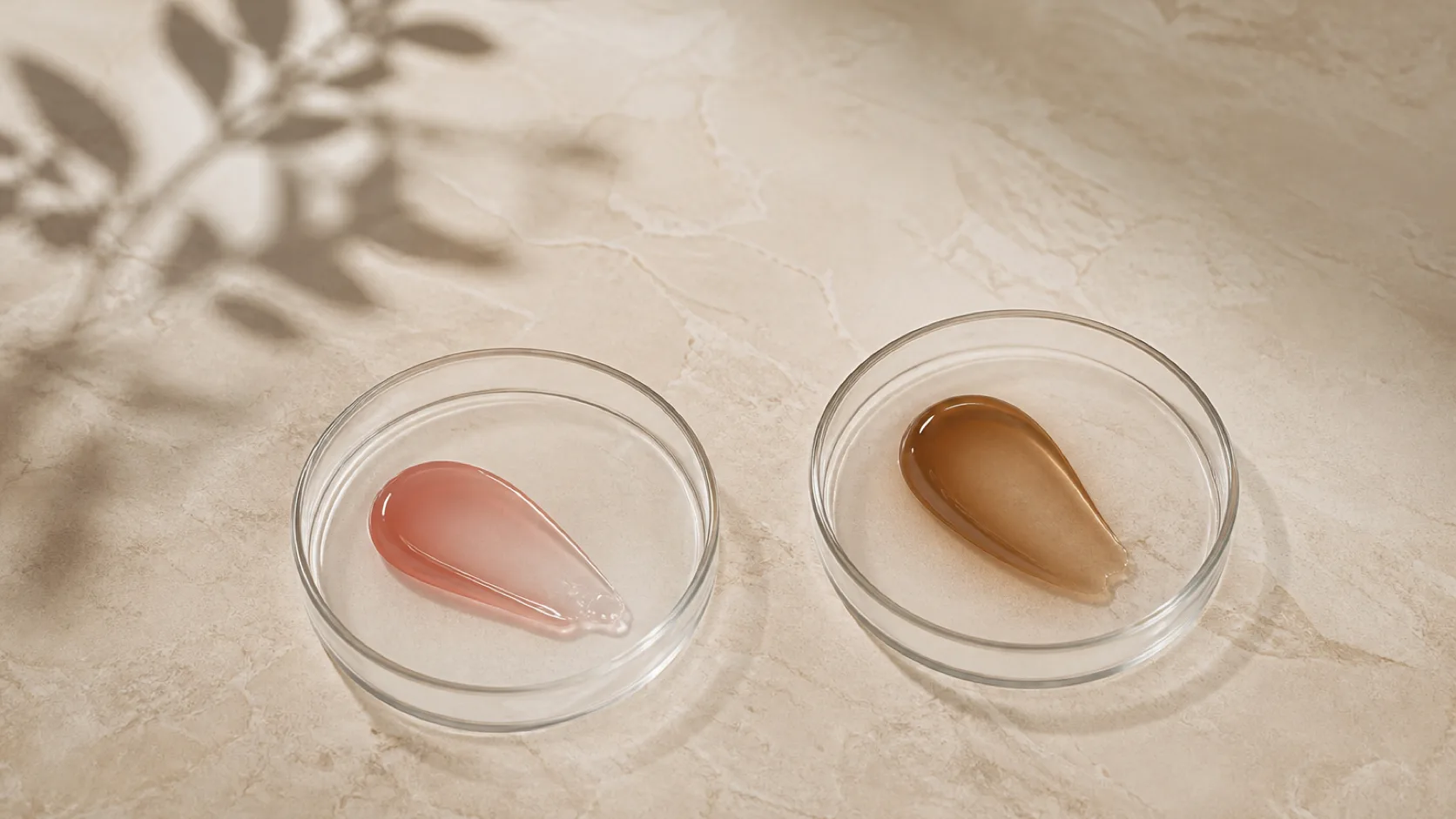
Red and dark acne marks are different conditions. Red acne marks (PIE) come from small blood vessels beneath the skin after inflammation, while dark acne marks (PIH) come from melanin pigment. A simple first check is to press gently on the mark: red marks usually fade briefly, while dark marks usually stay the same. Both fade over time but on different timelines and need different care. Results vary by individual.
What Is the Difference Between Red and Dark Acne Marks
Red and dark acne marks differ from the very cause. Red marks (post-inflammatory erythema, PIE) are about “blood vessels,” while dark marks (post-inflammatory hyperpigmentation, PIH) are about “pigment.” Because the causes differ, so do the care approach and how long they take to fade.
Red acne marks appear after acne inflammation, when the small blood vessels in the skin dilate and the microvasculature changes while the skin repairs itself, so the marks look red, pink, or purplish. According to DermNet, marks like this are more visible in lighter or thinner skin, because the changes in the blood vessels beneath the surface are easier to see.
Dark acne marks form through a different mechanism: after inflammation, the pigment-producing cells (melanocytes) are stimulated to make more melanin and transfer it to surrounding skin cells, producing marks that range from light brown to dark brown or black. DermNet explains that dark marks like this are more common and tend to persist longer in people with darker skin, which includes many Thai and Asian people with Fitzpatrick III–V skin tones. This matters because one person may have both red and dark marks mixed together, or red marks may gradually turn into dark marks over time. Both of these are also a different thing from acne scars, which are changes in texture, not just in color.
| Point of comparison | Red acne marks (PIE) | Dark acne marks (PIH) |
|---|---|---|
| Main cause | Small blood vessels dilating/changing after inflammation | Extra melanin produced after inflammation |
| Color you see | Red, pink, purplish | Light brown, dark brown, to black |
| Press test on the skin | Usually fades briefly (because it is vascular) | Usually stays the same (because it is pigment) |
| More common in | Lighter/thinner skin, more visible | Darker (Asian) skin, more common and longer-lasting |
| Approximate self-fade time | About 2–6 months | About 6–12 months; deeper layers can take a year or more |
| Approaches that tend to help | Time, sun protection, gentle skincare, vascular lasers | Sun protection, pigment-reducing topicals, Pico Laser |
How Can You Tell Whether a Mark Is Red or Dark
A simple first check you can do yourself is to look at the “color” and gently “press” on the mark, because red and dark marks come from different mechanisms and so respond differently to pressure. However, self-observation is only a rough guide, not a diagnosis, and should be confirmed by a doctor.
The simple principles are:
- Look at the color — marks that are red, pink, or purplish are usually red marks (PIE), while marks that are light brown to dark brown or black are usually dark marks (PIH).
- Press gently and observe — when you press on a red mark, blood is briefly pushed out of the small vessels, so the mark tends to fade or disappear for a moment and then turn red again. A dark mark, which is pigment within the skin, usually does not change when pressed.
- Feel the texture — if the skin still feels smooth to the touch, the issue is one of color (red/dark marks), but if it feels like a sunken groove, it may be an acne scar, which is a different matter.
In reality, many people have both red and dark marks together, and some red marks may gradually turn into dark marks over time, especially in darker skin exposed to the sun. Telling clearly which is the main problem affects the choice of care, because red marks, which are vascular, and dark marks, which are pigment, respond to different groups of methods. If you are unsure, having an experienced doctor assess your skin in person tells them apart more accurately than guessing from a photo.
How Are Red and Dark Acne Marks Different From Acne Scars
The most important difference is that red and dark marks are changes in skin “color” while the skin stays smooth, whereas acne scars are changes in skin “texture,” where the skin sinks into grooves or pits and feels uneven to the touch.
DermNet explains that post-inflammatory color changes (red and dark marks) are a different process from the formation of depressed scars (acne scars), even though both follow acne, and they can occur together. This difference matters because it determines a different care approach. Red and dark marks are a matter of color that tends to fade over time and responds to sun protection, topicals, or certain lasers. Acne scars are a matter of skin structure that has sunk, where care focuses on stimulating collagen or resurfacing the texture.
For this reason, telling them apart early helps set more accurate expectations. If the main problem is dark or red marks, sun protection and skincare may show a change over a period of months, but if it is acne scars, it usually requires specific procedures and takes longer. If you suspect you also have acne scars, you can read a comparison of the different methods in the article Acne Scar Treatments Compared to understand them before deciding.
Do Red Acne Marks Fade on Their Own, and How Should You Care for Them
Most red acne marks gradually fade on their own. Dermatology sources indicate that post-inflammatory red marks usually fade over a range of about 2–6 months, but in some people, especially those with darker skin or repeated inflammatory acne, red marks may last longer and overlap with dark marks. Results vary by individual.
Because red marks are a matter of blood vessels, the care approach differs from that for dark marks. Things that tend to help include:
- Give it time and keep skincare gentle — avoid scrubbing or irritating products, because repeated irritation can keep the skin red for longer.
- Use sun protection consistently — although red marks are not as sun-sensitive as dark marks, sun protection reduces inflammation and lowers the chance that red marks turn into dark marks.
- Calm active acne — because new inflammatory acne keeps producing more red marks.
- Vascular lasers — for persistent red marks, a doctor may consider lasers designed specifically for blood vessels, which are a different group from lasers used for pigment. Several clinical studies published via NIH/PubMed have examined lasers in this group for post-acne redness, and results vary by individual.
A point to note is that lasers or topicals designed for “pigment” may not help much with red marks, which are “vascular.” The method should therefore match the type of mark, which is why having a doctor assess first helps you avoid spending time and money on an approach that does not fit the problem.
Do Dark Acne Marks Fade on Their Own, and How Should You Care for Them
Dark acne marks also fade on their own, but usually take longer than red marks. Information from the American Academy of Dermatology indicates that a mark a few shades darker than normal skin usually fades within about 6–12 months, while deeper discoloration can take a year or more, and in darker skin, dark marks tend to persist longer than in lighter skin. Results vary by individual.
Because dark marks are a matter of pigment, the care approach focuses on reducing pigment production and preventing it from darkening. Things that tend to help include:
- Sun protection first — the AAD emphasizes that a broad-spectrum sunscreen of SPF 30 or higher both reduces new dark marks and helps existing ones fade. UV light is a major factor in making dark marks darker and slower to fade.
- Pigment-reducing topicals — such as vitamin A derivatives (retinoids), vitamin C, azelaic acid, or niacinamide, which should be used under the guidance of a doctor or pharmacist, especially higher-concentration actives.
- Treat acne at the source — the AAD notes that keeping active acne under control is an important step in reducing new dark marks.
- Pico Laser — for dark marks that fade slowly or are fairly deep, picosecond lasers act on melanin pigment, so they are one option a doctor may consider. See the approach in detail on the Pico Laser page. The choice and number of sessions depend on the doctor’s assessment, and results vary by individual.
Because dark acne marks share a similar mechanism with dark spots and pigment from other causes, understanding pigment in general helps with care. If you are interested in melasma, freckles, and dark spots, you can read more in the article Melasma, Freckles, and Dark Spots Compared. Be careful with using whitening products or strong topicals on your own without consulting, because the irritation may create more dark marks instead.
What Makes Acne Marks Fade More Slowly or Get Darker
Although most acne marks fade over time, certain behaviors make them fade more slowly, get darker, or raise the risk of turning into acne scars. Avoiding these factors is therefore as important as treatment.
- Picking, squeezing, or scratching acne — deepens and prolongs inflammation, raising the chance of dark marks, red marks, and acne scars.
- Sun exposure without protection — UV light stimulates pigment, clearly making dark marks darker and slower to fade.
- Leaving inflammatory acne untreated for a long time — the more severe and prolonged the inflammation, the higher the risk of dark marks and pits.
- Using products that irritate the skin — harsh scrubbing or strong acids that do not suit your skin can inflame it and create more dark marks.
Put simply, the two things that harm acne marks most are “picking” and “the sun.” Controlling these two factors, together with treating acne at the source, is usually the foundation that helps marks fade naturally, before considering additional procedures.
Summary and Consulting a Doctor
Red and dark acne marks are different conditions: red marks (PIE) are about blood vessels, while dark marks (PIH) are about pigment, and both differ from acne scars, which are changes in texture. Telling which is the main problem helps you choose the right care approach. Both tend to fade over time, with sun protection and not picking as the key foundation, while a procedure like Pico Laser is an option a doctor may consider for dark marks that fade slowly. Results vary by individual. If you are unsure which type of mark you have, or the marks fade more slowly than expected, you can come in for an experienced doctor at Onnyx Clinic to assess your skin and create an individualized plan. Message us with questions and to make an appointment via LINE @onnyxclinic.
References
- American Academy of Dermatology — How to fade dark spots in darker skin tones
- DermNet — Acne scarring
- DermNet — Postinflammatory hyperpigmentation
- NCBI StatPearls — Postinflammatory Hyperpigmentation
- NIH / PubMed Central — Postinflammatory Hyperpigmentation: A Review of the Epidemiology, Clinical Features, and Treatment Options in Skin of Color
- NIH / PubMed Central — Treatment of post-acne erythema (long-pulsed Nd:YAG laser)
Frequently asked questions
What is the difference between red and dark acne marks? +
Red acne marks (PIE) come from small blood vessels beneath the skin dilating after inflammation, so they look red or pink. Dark acne marks (PIH) come from excess melanin produced after inflammation, so they look brown to black. A simple check is to press gently on the mark: red marks usually fade briefly, while dark marks usually stay the same.
Do acne marks fade on their own, and how long does it take? +
Most acne marks gradually fade over time. Red marks usually take around 2–6 months, while dark marks in the upper skin layer usually take around 6–12 months, and deeper or darker-skin marks can take a year or more. Sun protection and proper care help them fade faster. Results vary by individual.
How are red and dark acne marks different from acne scars (pits)? +
Red and dark marks are changes in skin 'color' while the skin stays smooth, whereas acne scars are changes in skin 'texture,' where the skin sinks into grooves and feels uneven to the touch. They are cared for in different ways, so it helps to tell them apart before planning.
Does sunscreen really help with acne marks? +
Yes, especially for dark marks, because UV light drives pigment to darken and fade more slowly. Dermatologists generally recommend a broad-spectrum sunscreen of SPF 30 or higher applied consistently, which both reduces new marks and helps existing ones fade.
How does Pico Laser help with dark acne marks? +
Picosecond lasers (Pico Laser) act on melanin pigment, so they are one option a doctor may consider for dark marks that fade slowly or are fairly deep. Red marks, which are vascular, are usually addressed differently. The choice depends on the doctor's assessment, and results vary by individual.
When and where should I see a doctor about acne marks? +
If acne marks fade more slowly than expected, keep getting darker, or you are unsure whether they are red marks, dark marks, or acne scars, a doctor's assessment helps match the plan to the problem. You can consult an experienced doctor at Onnyx Clinic and ask for more details via LINE @onnyxclinic.

Written by Onnyx Clinic Editorial Team
Medically reviewed by Dr. Janthida Gluayjumnong · Attending Physician, Onnyx Clinic · ว.74005
Last reviewed July 5, 2026
Doctor →Related articles

Acne
Subcision for Acne Scars: What It Is and Which Scars It Suits
What Subcision is, how it suits rolling acne scars, the steps, downtime, sessions, and why it is often paired with laser, by the Onnyx Clinic medical team.

Acne
Acne Face Mapping: What Location Really Tells You
Does acne face mapping work? Why linking spots to organs lacks evidence, and what acne location really signals — by the Onnyx Clinic medical team
Acne
Acne Extraction vs Injection: Which Suits Your Acne
Acne extraction vs injection: extraction removes clogged comedones with sterile tools, while injection delivers anti-inflammatory medicine into large nodules.
Ready to take care of yourself?
Consult a doctor and book any day via LINE.
Chat on LINE · @onnyxclinic